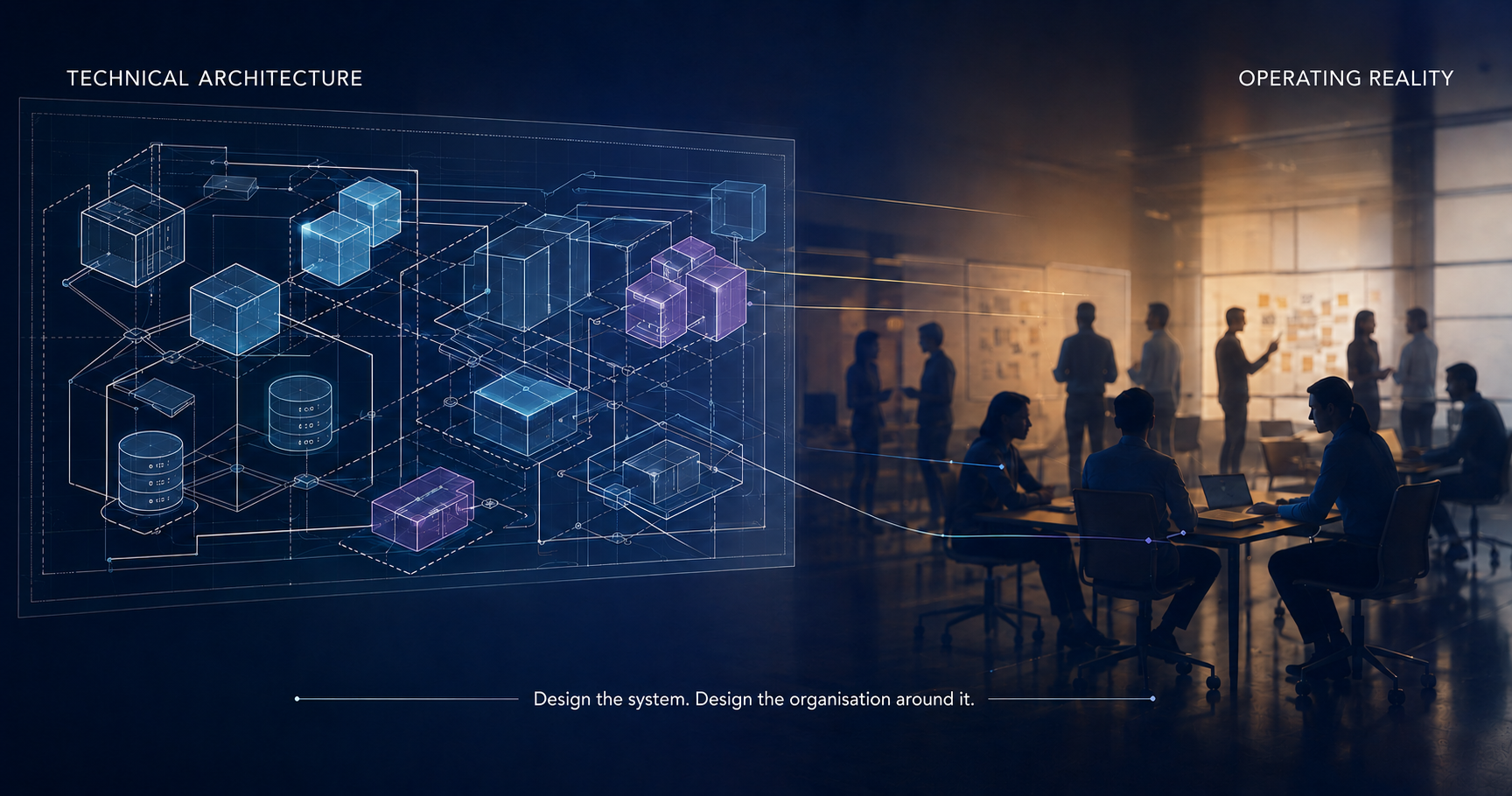
The diagram is clean. The boxes connect. The chosen platform can scale, the integration pattern is sensible, and security has a place on the page. The meeting ends with confidence, because every hard technical question appears to have an answer.
Then the real work starts.
Three months later, one team is waiting for another team to approve a change. Six months later, the data platform is technically live but the business still reconciles its numbers in spreadsheets. Nine months later, an AI capability has passed its pilot, yet nobody can say who owns its behaviour when the model, data or business policy changes.
The technology did not necessarily fail. The organisation never finished the design.
The architecture decision is only half the story. The other half is the organisation that must live with it.
This is not an argument for adding more governance meetings or producing a larger responsibility matrix. It is an argument for treating ownership, decision flow and operational learning as part of the architecture—not as activities to arrange after the “real” design is complete.
Change — architecture is no longer the scarce part
Good reference architectures are widely available. Cloud providers document proven patterns. Platforms package capabilities that once took years to assemble. Infrastructure can be provisioned in minutes, and an AI-assisted team can create a convincing prototype before the operating questions have even been asked.
This is progress. But it changes where the difficult work sits.
The constraint is increasingly not whether an organisation can draw or deploy the target architecture. It is whether the surrounding organisation can make decisions at the speed, ownership boundary and risk level that the architecture assumes.
A domain-oriented data platform, for example, assumes that domains can own the meaning and quality of their data. A product operating model assumes that a durable team can improve a capability beyond its initial project funding. An AI agent assumes that someone is accountable not only for availability, but also for the quality of its decisions, the context it uses and the conditions under which a human must intervene.
Those assumptions often remain invisible in the diagram.
Mel Conway described the underlying relationship in 1968: organisations are constrained to design systems that reflect their communication structures. The observation is still useful, but I would take it one step further for today’s cloud, data and AI programmes. The organisation does not merely influence the shape of the system. It also determines how quickly that system can be changed, challenged and recovered once it meets reality.
Fit — there are always two architectures
Every material technology decision creates two connected designs.
The first is the system architecture: services, data flows, interfaces, controls, deployment patterns and the technical boundaries between components.
The second is the organisation architecture: who can decide, who owns the outcome, where expertise sits, how work crosses boundaries and how evidence travels back to the people able to act on it.
We tend to review the first architecture rigorously and describe the second with optimistic verbs: the teams will collaborate, the business will adopt, the platform team will enable, governance will oversee.
Those verbs conceal design decisions.
If a product team needs four external approvals to release a low-risk change, it is not autonomous in practice. If a data domain is accountable for quality but cannot prioritise engineering capacity, it does not truly own quality. If an AI risk committee can stop a deployment but no operational team owns continuous evaluation, governance exists at the gate and disappears during the life of the system.
DORA’s research on loosely coupled teams makes the relationship concrete: independent delivery requires both a technical architecture and an organisational structure that reduce dependencies and communication overhead. Technical modularity without decision autonomy produces an architecture that is loosely coupled on paper and tightly coupled in operation.

Reality — the five spans between design and outcome
Across cloud transformations, data platforms and more recent AI initiatives, I keep returning to five questions. Together they form what I call the Architecture-to-Outcome Bridge.
1. Decision rights — who can decide, and within what boundary?
Architecture creates boundaries. The operating model must attach decision rights to them.
Teams should know which choices they can make independently, which require consultation and which require explicit approval. The aim is not unrestricted autonomy. It is autonomy matched to risk, with escalation paths that are clear before an urgent decision arrives.
When decision rights are vague, organisations compensate with meetings. The calendar becomes the integration layer.
2. End-to-end ownership — who remains when the project leaves?
A programme can build a platform. Only an owner can keep it worth using.
End-to-end ownership includes reliability, security, cost, data quality, adoption and the ongoing fitness of the capability for its intended outcome. Different specialists will contribute, but one durable team or accountable leader must be able to see the whole.
This is where many projects create an operational gap. The programme is funded to reach go-live; the organisation is not designed to learn after go-live.
3. Operating rhythm — how does work move when priorities compete?
Technology does not operate through an organisation chart. It operates through backlogs, funding cycles, incident reviews, release practices and the everyday negotiations between teams.
An effective rhythm connects strategy to delivery and delivery back to learning. It makes space for platform health, technical debt and adoption—not only new features. It also reduces the number of exceptional paths a team must invent to get ordinary work done.
Microsoft’s Azure Well-Architected guidance treats operational requirements as being as important as business requirements, and emphasises shared responsibility, clear ownership, observability and learning. That is useful because it moves operations from a support conversation to a design conversation.
4. Guardrails — how is freedom made safe?
Central control does not scale to every cloud resource, data product or AI interaction. Unbounded freedom does not scale either.
Guardrails turn policy into reusable paths: identity patterns, deployment controls, cost thresholds, data classifications, approved model routes, evaluation requirements and clear conditions for human review. They let teams move without asking permission for every ordinary decision, while making risk visible when the boundary is crossed.
For AI, this accountability must continue through the lifecycle. The NIST AI Risk Management Framework explicitly calls for documented roles, responsibilities and lines of communication for mapping, measuring and managing AI risk. A model approval at launch is not a substitute for ownership when performance, data or context changes.
Operational autonomy should be earned—not assumed. Evidence earns it; guardrails protect it.
5. Feedback and evidence — how will we know the decision still works?
Architecture review asks whether a design should work. Operations reveal whether it does.
The feedback loop should include technical signals such as reliability, latency, security events and cost, but it cannot stop there. It also needs adoption, decision quality, user friction and business outcomes. Otherwise a system can be healthy in the dashboard and irrelevant in the organisation.
The important question is not simply, “Did we deliver the architecture?” It is, “What evidence would cause us to keep it, change it or stop it?”
A composite example — the platform that was live but not owned
Consider a composite situation drawn from a pattern I have seen in different forms over the years.
An enterprise selects a modern cloud data and AI platform. The architecture is credible: governed ingestion, a common data layer, semantic models, role-based access, automated deployment and a path for machine-learning workloads. The programme delivers the foundational platform and two high-visibility use cases.
The launch is celebrated. Then four fractures appear.
- Finance and Sales still use different definitions for a key measure, and neither team has authority to settle it.
- The platform team owns infrastructure availability but not the usefulness or adoption of the data products running on it.
- Model monitoring exists technically, yet no business owner is accountable for deciding when degraded performance changes a customer process.
- Cloud costs are visible, but they sit in a central budget far from the teams whose design choices create them.
None of these is fixed by changing the database, adding another dashboard or selecting a different model. They are gaps in the organisation architecture.
Now apply the five spans.
The executive sponsor gives named domain owners the right to approve business definitions within agreed enterprise principles. Durable product teams own data products through reliability, adoption and value—not merely delivery. An AI service has explicit technical, business and risk owners, with thresholds that trigger review. Cost is allocated and discussed alongside usage and outcomes. A monthly operating review examines evidence and removes cross-team blockers rather than replaying project status.
The technical architecture has barely changed. Its ability to produce an outcome has.
Outcome — review the operating design before approving the target design
An architecture review should not end when the reviewers agree that the components fit together. Before approval, leaders should be able to answer five operating questions with the same confidence.
These are not review questions. They are approval conditions.
- Decision rights: Which decisions can the owning team make, and where are the risk boundaries?
- Ownership: Who remains accountable for reliability, cost, adoption and value after the programme closes?
- Operating rhythm: Through which backlog, funding path and review cadence will the capability evolve?
- Guardrails: Which controls are built into the path, and which conditions require escalation or human judgement?
- Evidence: What measures will tell us whether the architecture is useful—not merely available?
These questions expose trade-offs early. A highly standardised platform may improve control but create a queue around a central team. A federated data model may improve domain relevance but require investment in shared semantics and stronger product ownership. An ambitious AI capability may accelerate decisions but demand new evaluation, monitoring and accountability disciplines.
There is no universal operating model. There must be a deliberate one.
The Decode
Architecture matters. A poor technical choice can create years of friction, risk and avoidable cost. But a technically elegant design does not carry its own ownership, align incentives or create the feedback needed to improve.
That work belongs to people.
The strongest architecture leaders I have worked with do more than defend a diagram. They make the hidden organisational assumptions discussable. They ask who will operate the system at 2 a.m., who can change it on an ordinary Tuesday, who resolves a contested definition and who has the evidence—and the authority—to say that the original decision is no longer serving the business.
The architecture decision is only half the story.
The other half begins when the meeting ends.